When Uploading to Jouranl Bib Refernce Dont Show Up
Contents
- 1 Advisory note
- 2 Introduction
- three Bibliography: but a list of \bibitems
- 3.1 A note on compilation times
- 4 Enter \(\mathrm{Bib\TeX}\)
- 4.one Some notes on using \(\mathrm{Bib\TeX}\) and .bib files
- five Taking another look at .bib files
- 5.1 Multiple authors in \(\mathrm{Bib\TeX}\)
- 5.2 Multiple-word last names
- five.3 I tried to use % to comment out some lines or entries in my .bib file, but I got lots of error messages instead?
- vi How/where do I really become those .bib files?
- 6.1 Edit the .bib file every bit manifestly text
- 6.2 Assist from GUI-based .bib editors
- half dozen.iii Export from reference library services
- 6.four I've already got a reference list in a Microsoft Word/HTML/PDF file; can I somehow reuse the data without re-typing everything?
- 7 Summary and farther reading
- 7.1 Further reading
Advisory note
If you are starting from scratch we recommend using biblatex because that bundle provides localization in several languages, it'south actively developed and makes bibliography direction easier and more flexible.
Introduction
Many tutorials accept been written nigh what \(\mathrm{Bib\TeX}\) is and how to use it. Nonetheless, based on our experience of providing support to Overleaf's users, it's still one of the topics that many newcomers to \(\mathrm{\LaTeX}\) find complicated—especially when things don't become quite right; for example: citations aren't appearing; problems with authors' names; not sorted to a required order; URLs not displayed in the references list, and so forth.
In this article nosotros'll pull together all the threads relating to citations, references and bibliographies, also as how Overleaf and related tools can assistance users manage these.
We'll first with a quick recap of how \(\mathrm{Bib\TeX}\) and bibliography database (.bib) files piece of work and look at some means to prepare .bib files. This is, of course, running the risk of repeating some of the material contained in many online tutorials, but future articles volition expand our coverage to include bibliography styles and biblatex—the alternative bundle and bibliography processor.
Bibliography: just a list of \bibitems
Let'due south get-go accept a quick expect "under the hood" to see what a \(\mathrm{\LaTeX}\) reference listing is comprised of—please don't start coding your reference list like this because later in this article we'll look at other, more convenient, means to practise this.
A reference list actually only a thebibliography listing of \bibitems:
\begin {thebibliography}{ix} \bibitem {texbook} Donald E. Knuth (1986) \emph {The \TeX {} Book}, Addison-Wesley Professional person. \bibitem {lamport94} Leslie Lamport (1994) \emph { \LaTeX: a document training organization}, Addison Wesley, Massachusetts, 2nd ed. \terminate {thebibliography}
By default, this thebibliography surroundings is a numbered list with labels [1], [2] and and then forth. If the document course used is article, \begin{thebibliography} automatically inserts a numberless section heading with \refname (default value: References). If the certificate class is book or report, and so a numberless chapter heading with \bibname (default value: Bibliography) is inserted instead. Each \bibitem takes a cite key as its parameter, which yous tin employ with \cite commands, followed by data most the reference entry itself. And so if you lot now write
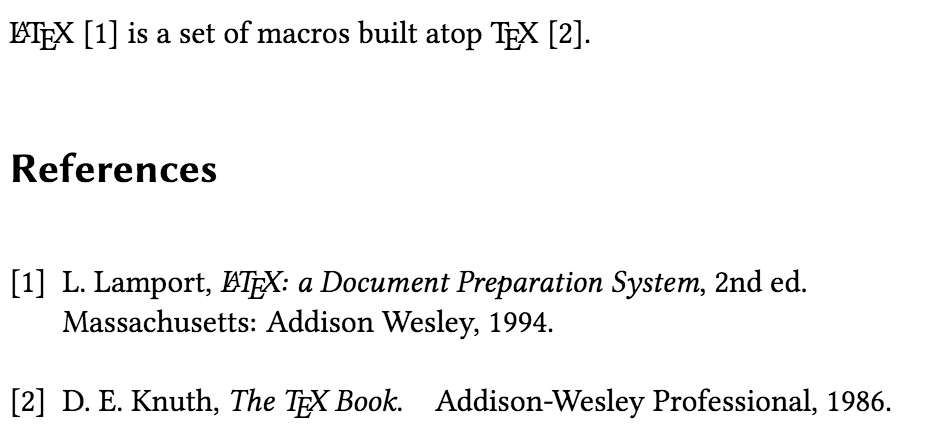
\LaTeX {} \cite {lamport94} is a set of macros congenital atop \TeX {} \cite {texbook}.
together with the thebibliography block from before, this is what gets rendered into your PDF when y'all run a \(\mathrm{\LaTeX}\) processor (i.e. whatever of latex, pdflatex, xelatex or lualatex) on your source file:
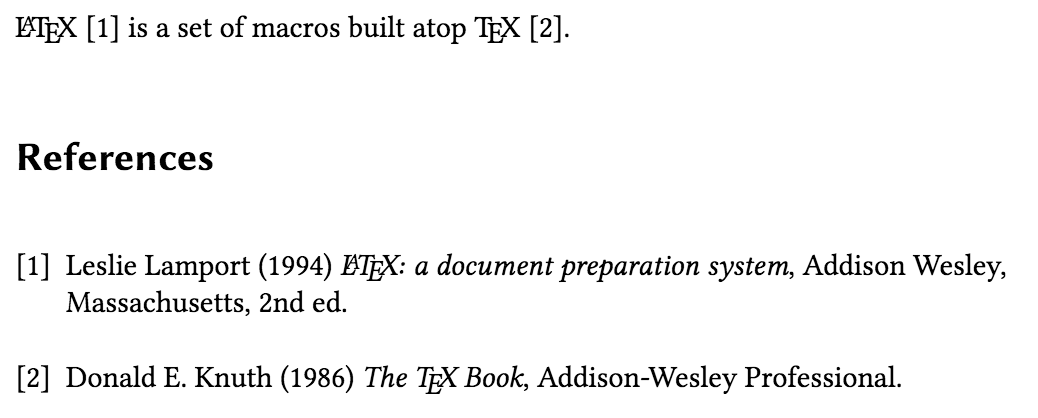
Figure 1: Citing entries from a thebibliography listing.
Notice how each \bibitem is automatically numbered, and how \cite then inserts the corresponding numerical characterization.
\begin{thebibliography} takes a numerical statement: the widest label expected in the list. In this example we only accept two entries, so 9 is enough. If you have more than than x entries, though, yous may notice that the numerical labels in the listing start to get misaligned:
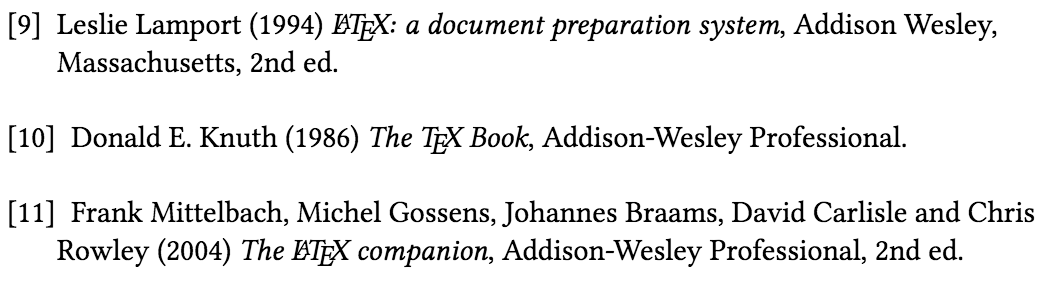
Figure 2: thebibliography with a label that'due south too curt.
We'll have to brand information technology \brainstorm{thebibliography}{99} instead, and so that the longest label is wide enough to accommodate the longer labels, like this:
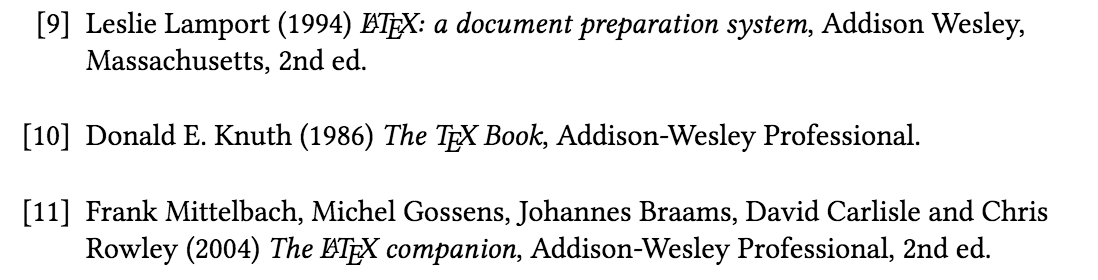
Effigy 3: thebibliography with a longer label width.
If you lot compile this case code snippet on a local computer y'all may notice that after the beginning time you run pdflatex (or another \(\mathrm{\LaTeX}\) processor), the reference list appears in the PDF as expected, but the \cite commands just show up as question marks [?].
This is because after the offset \(\mathrm{\LaTeX}\) run the cite keys from each \bibitem (texbook, lamport94) are written to the .aux file and are non yet available for reading by the \cite commands. Simply on the 2d run of pdflatex are the \cite commands able to look up each cite key from the .aux file and insert the corresponding labels ([i], [2]) into the output.
On Overleaf, though, y'all don't have to worry almost re-running pdflatex yourself. This is because Overleaf uses the latexmk build tool, which automatically re-runs pdflatex (and another processors) for the requisite number of times needed to resolve \cite outputs. This also accounts for other cross-referencing commands, such as \ref and \tableofcontents.
A note on compilation times
Processing \(\mathrm{\LaTeX}\) reference lists or other forms of cross-referencing, such as indexes, requires multiple runs of software—including the \(\mathrm{\TeX}\) engine (e.chiliad., pdflatex) and associated programs such equally \(\mathrm{Bib\TeX}\), makeindex, etc. Equally mentioned above, Overleaf handles all of these mulitple runs automatically, so y'all don't have to worry about them. As a consequence, when the preview on Overleaf is refreshing for documents with bibliographies (or other cross-referencing), or for documents with large image files (as discussed separately here), these essential compilation steps may sometimes brand the preview refresh appear to take longer than on your ain machine. We do, of grade, aim to keep information technology as curt as possible! If you experience your document is taking longer to compile than you'd look, hither are some further tips that may help.
Enter \(\mathrm{Bib\TeX}\)
There are, of course, some inconveniences with manually preparing the thebibliography list:
- It's up to you to accurately format each
\bibitembased on the reference way y'all're asked to apply—which bits should exist in bold or italic? Should the year come immediately later the authors, or at the end of the entry? Given names first, or last names outset? - If you're writing for a reference style which requires the reference list to be sorted by the final names of first authors, you'll need to sort the
\bibitems yourself. - For different manuscripts or documents that use different reference styles yous'll need to rewrite the
\bibitemfor each reference.
This is where \(\mathrm{Bib\TeX}\) and bibliography database files (.bib files) are extremely useful, and this is the recommended approach to manage citations and references in most journals and theses. The biblatex approach, which is slightly different and gaining popularity, also requires a .bib file but we'll talk nearly biblatex in a future post.
Instead of formatting cited reference entries in a thebibliography list, we maintain a bibliography database file (let's proper noun it refs.bib for our instance) which contains format-independent information nearly our references. So our refs.bib file may look like this:
@book{texbook, author = {Donald E. Knuth}, year = {1986}, championship = {The { \TeX } Volume}, publisher = {Addison-Wesley Professional} } @book{latex:companion, author = {Frank Mittelbach and Michel Gossens and Johannes Braams and David Carlisle and Chris Rowley}, year = {2004}, championship = {The { \LaTeX } Companion}, publisher = {Addison-Wesley Professional}, edition = {2} } @book{latex2e, writer = {Leslie Lamport}, year = {1994}, championship = {{ \LaTeX }: a Document Preparation System}, publisher = {Addison Wesley}, address = {Massachusetts}, edition = {2} } @commodity{knuth:1984, title={Literate Programming}, writer={Donald Due east. Knuth}, periodical={The Computer Journal}, volume={27}, number={ii}, pages={97--111}, year={1984}, publisher={Oxford University Press} } @inproceedings{lesk:1977, title={Computer Typesetting of Technical Journals on {UNIX}}, author={Michael Lesk and Brian Kernighan}, booktitle={Proceedings of American Federation of Data Processing Societies: 1977 National Calculator Conference}, pages={879--888}, year={1977}, accost={Dallas, Texas} }
Yous tin can find more than information about other \(\mathrm{Bib\TeX}\) reference entry types and fields here—there's a huge table showing which fields are supported for which entry types. We'll talk more about how to set up .bib files in a later section.
Now we can utilize \cite with the cite keys as before, but at present nosotros replace thebibliography with a \bibliographystyle{...} to choose the reference manner, every bit well as \bibliography{...} to point \(\mathrm{Bib\TeX}\) at the .bib file where the cited references should exist looked-up.
\LaTeX {} \cite {latex2e} is a gear up of macros built atop \TeX {} \cite {texbook}. \bibliographystyle {plain} % Nosotros choose the "patently" reference manner \bibliography {refs} % Entries are in the refs.bib file
This is processed with the following sequence of commands, assuming our \(\mathrm{\LaTeX}\) certificate is in a file named chief.tex (and that nosotros are using pdflatex):
-
pdflatex principal -
bibtex main -
pdflatex main -
pdflatex chief
and we get the following output:
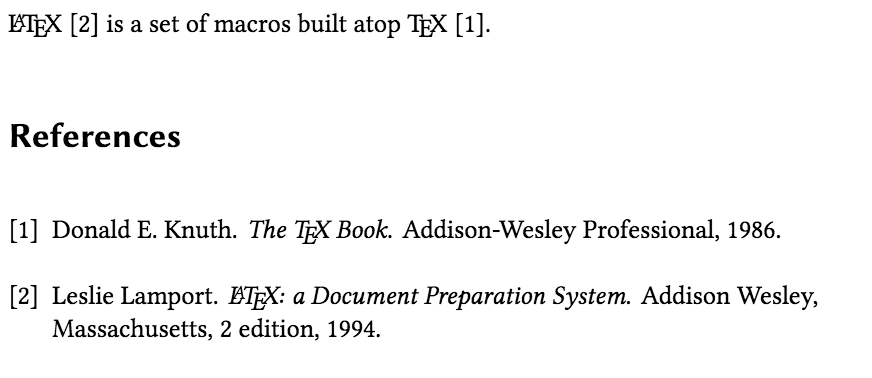
Figure 4: \(\mathrm{Bib\TeX}\) output using the plain bibliography manner.
Whoah! What's going on here and why are all those (repeated) processes required? Well, here'due south what happens.
-
During the outset
pdflatexrun, allpdflatexsees is a\bibliographystyle{...}and a\bibliography{...}frommaster.tex. It doesn't know what all the\cite{...}commands are about! Consequently, within the output PDF, all the\cite{...}commands are only rendered as [?], and no reference list appears, for at present. Butpdflatexwrites information well-nigh the bibliography manner and.bibfile, as well as all occurrences of\cite{...}, to the filemain.aux. -
It'due south really
main.auxthat \(\mathrm{Bib\TeX}\) is interested in! It notes the.bibfile indicated by\bibliography{...}, then looks up all the entries with keys that match the\cite{...}commands used in the.texfile. \(\mathrm{Bib\TeX}\) then uses the style specified with\bibliographystyle{...}to format the cited entries, and writes a formattedthebibliographylist into the filechief.bbl. The product of the.bblfile is all that's achieved in this step; no changes are made to the output PDF. -
When
pdflatexis run over again, information technology now sees that amain.bblfile is available! So it inserts the contents ofmain.bbli.e. the\begin{thebibliography}....\end{thebibliography}into the \(\mathrm{\LaTeX}\) source, where\bibliography{...}is. Subsequently this step, the reference listing appears in the output PDF formatted according to the chosen\bibliographystyle{...}, simply the in-text citations are still [?]. -
pdflatexis run over again, and this time the\cite{...}commands are replaced with the corresponding numerical labels in the output PDF!
Every bit before, the latexmk build tool takes care of triggering and re-running pdflatex and bibtex as necessary, so you don't take to worry nearly this bit.
Some notes on using \(\mathrm{Bib\TeX}\) and .bib files
A few farther things to notation about using \(\mathrm{Bib\TeX}\) and .bib files:
- You may have noticed that although
refs.bibcontained five \(\mathrm{Bib\TeX}\) reference entries, only two are included in the reference listing in the output PDF. This is an important point nigh \(\mathrm{Bib\TeX}\): the.bibfile's part is to store bibliographic records, and just entries that have been cited (via\cite{...}) in the.texfiles will appear in the reference list. This is like to how only cited items from an EndNote database volition exist displayed in the reference list in a Microsoft Give-and-take document. If you exercise want to include all entries—to be displayed but without actually citing all of them—you can write\nocite{*}. This besides means you tin reuse the same.bibfile for all your \(\mathrm{\LaTeX}\) projects: entries that are not cited in a particular manuscript or report will be excluded from the reference list in that document. - \(\mathrm{Bib\TeX}\) requires one
\bibliographystyle{...}and one\bibliography{...}to office correctly—in future posts we'll encounter how to create multiple bibliographies in the same document. If you lot keep getting "undefined citation" warnings, check that you take indeed included those 2 commands, and that the names are spelled correctly. File extensions are not normally required, just carry in mind that file names are case sensitive on some operating systems—including on Overleaf! Therefore, if y'all typed\bibliographystyle{IEEetran}(note the typo: "east") instead of\bibliographystyle{IEEEtran}, or wrote\bibliography{refs}when the actual file name isRefs.bib, you'll get the dreaded [?] every bit citations. - In the same vein, treat your cite keys as case-sensitive, always. Use the exact same case or spelling in your
\cite{...}equally in your.bibfile. - The order of references in the
.bibfile does non have whatever effect on how the reference listing is ordered in the output PDF: the sorting order of the reference list is adamant by the\bibliographystyle{...}. For example, some readers might accept noticed that, within my before case, the first citation in the textlatex2eis numbered [2], while the second citation in the text (texbook) is numbered [ane]! Take \(\mathrm{\LaTeX}\) and \(\mathrm{Bib\TeX}\) lost the plot? Not at all: this is actually because theplainway sorts the reference list by alphabetical order of the first author's last name. If yous adopt a scheme where the numerical commendation labels are numbered sequentially throughout the text, you'll accept to choose a bibliography style which implements this. For instance, if instead we had used\bibliographystyle{IEEEtran}for that example, we'd get the post-obit output. Notice also how the formatting of each cited item in the reference list has automatically updated to suit the IEEE'due south style:
Effigy 5: IEEEtran bibliography way output.
Nosotros'll talk more than almost different bibliography styles, including author–year citation schemes, in a hereafter article. For at present, let's turn our attention to .bib file contents, and how we can make the task of preparing .bib files a fleck easier.
Taking some other await at .bib files
As you may have noticed earlier, a .bib file contains \(\mathrm{Bib\TeX}\) bibliography entries that showtime with an entry type prefixed with an @. Each entry has a some primal–value \(\mathrm{Bib\TeX}\) fields, placed within a pair of braces ({...}). The cite central is the first slice of data given within these braces, and every field in the entry must be separated by a comma:
@article{knuth:1984, title={Literate Programming}, writer={Donald E. Knuth}, journal={The Reckoner Journal}, volume={27}, number={2}, pages={97--111}, year={1984}, publisher={Oxford University Press} }
As a general rule, every bibliography entry should have an author, year and championship field, no thing what the type is. There are about a dozen entry types although some bibliography styles may recognise/define more than; however, it is probable that yous will most ofttimes use the following entry types:
-
@articlefor periodical articles (see example above). -
@inproceedingsfor conference proceeding articles:
@inproceedings{FosterEtAl:2003, writer = {George Foster and Simona Gandrabur and Philippe Langlais and Pierre Plamondon and Graham Russell and Michel Simard}, title = {Statistical Automobile Translation: Rapid Development with Limited Resources}, booktitle = {Proceedings of {MT Acme Ix}}, year = {2003}, pages = {110--119}, address = {New Orleans, USA}, }
-
@volumefor books (meet examples above). -
@phdthesis,@masterthesisfor dissertations and theses:
@phdthesis{Alsolami:2012, title = {An examination of keystroke dynamics for continuous user authentication}, school = {Queensland University of Technology}, writer = {Eesa Alsolami}, yr = {2012} }
-
@inbookis for a book affiliate where the entire book was written past the same author(s): the chapter of interest is identified by a affiliate number:
@inbook{peyret2012:ch7, title={Computational Methods for Fluid Flow}, edition={2}, author={Peyret, Roger and Taylor, Thomas D}, year={1983}, publisher={Springer-Verlag}, accost={New York}, affiliate={7, 14} }
-
@incollectionis for a contributed chapter in a book, and so would have its ownauthorandtitle. The actual championship of the entire book is given in thebooktitlefield; it is probable that aneditorfield will also exist present:
@incollection{Mihalcea:2006, author = {Rada Mihalcea}, championship = {Knowledge-Based Methods for {WSD}}, booktitle = {Discussion Sense Disambiguation: Algorithms and Applications}, publisher = {Springer}, yr = {2006}, editor = {Eneko Agirre and Philip Edmonds}, pages = {107--132}, address = {Dordrecht, the Netherlands} }
-
@miscis for whatever doesn't quite fit any other entry type. It can be peculiarly useful for spider web pages—by writing annotation = \url{http://...} or url = {http://...}:- you will often discover it useful to add
\usepackage{url}or\usepackage{hyperref}in your.texfiles' preamble (for more robust treatment of URLs); - not all bibliography styles support the
urlfield:plaindoesn't, justIEEEtrandoes. All styles supportnote. More on this in a future post; - you should be mindful that even web pages and
@miscentries should have anwriter, ayearand atitlefield:
- you will often discover it useful to add
@misc{web:lang:stats, author = {W3Techs}, title = {Usage Statistics of Content Languages for Websites}, year = {2017}, note = {Last accessed xvi September 2017}, url = {http://w3techs.com/technologies/overview/content_language/all} }
In a .bib file, commas are only used to separate the terminal name from the showtime proper noun of an author—if the last name is written outset. Individual author names are separated by and. So these are right:
writer = {Jane Doe and John Goodenough and Foo Bar}
or
author = {Doe, Jane and Goodenough, John and Bar, Foo}
But none of the post-obit will work correctly—you'll become weird output, or fifty-fifty fault messages from \(\mathrm{Bib\TeX}\)! And so take extra care if you are copying author names from a paper or from a web folio.
author = {Jand Doe, John Goodneough, Foo Bar} writer = {Jand Doe, John Goodneough and Foo Bar} author = {Jand Doe, John Goodneough, and Foo Bar}
Multiple-word last names
If an author'southward last name is made upwardly of multiple words separated by spaces, or if it's actually an organization, place an extra pair of braces effectually the last name so that \(\mathrm{Bib\TeX}\) volition recognise the grouped words as the concluding name:
author = {{World Health Organization}} author = {Geert {Van der Plas} and John Doe}
Alternatively, you tin can use the Lastname, Firstname format; some users find that clearer and more readable:
author = {Van der Plas, Geert and Doe, John}
Retrieve: Whether the offset or final name appears first in the output ("John Doe" vs "Doe, John"), or whether the showtime name is automatically abbreviated "J. Doe" or "Doe, J." vs "John Doe" "J. Doe"), all such details are controlled by the \bibliographystyle.
% is actually non a comment character in .bib files! And so, inserting a % in .bib files not only fails to annotate out the line, it too causes some \(\mathrm{Bib\TeX}\) errors. To get \(\mathrm{Bib\TeX}\) to ignore a particular field we just need to rename the field to something that \(\mathrm{Bib\TeX}\) doesn't recognise. For instance, if y'all want to keep a appointment field around simply prefer that it's ignored (possibly because you want \(\mathrm{Bib\TeX}\) to apply the year field instead) write Tdate = {...} or the more than human-readable IGNOREdate = {...}.
To go \(\mathrm{Bib\TeX}\) to ignore an unabridged entry you tin remove the @ before the entry type. A valid reference entry always starts with a @ followed past the entry blazon; without the @ character \(\mathrm{Bib\TeX}\) skips the lines until it encounters some other @.
How/where practise I actually get those .bib files?
Edit the .bib file every bit plain text
Because .bib files are plain text you can certainly write them by paw—once you're familiar with \(\mathrm{Bib\TeX}\)'s required syntax. But brand sure that y'all relieve it with a .bib extension, and that your editor doesn't surreptitiously add a .txt or some other suffix. On Overleaf you can click on the "Files…" link at the elevation of the file list console, and so on "Add blank file" to create a fresh .bib file to work on.
Pro tip: Did y'all know that Google Scholar search results can be exported to a \(\mathrm{Bib\TeX}\) entry? Click on the "Cite" link below each search result, and then on the "\(\mathrm{Bib\TeX}\)" option search. You lot tin can so copy the \(\mathrm{Bib\TeX}\) entry generated. Hither'south a video that demonstrates the procedure. Note that you should ever double-cheque the fields presented in the entry, every bit the automatically populated information isn't always comprehensive or accurate!
Help from GUI-based .bib editors
Many users prefer to use a dedicated \(\mathrm{Bib\TeX}\) bibliography database editor/manager, such every bit JabRef or BibDesk to maintain, edit and add together entries to their .bib files. Using a GUI can indeed assistance reduce syntax and spelling errors whilst creating bibliography entries in a \(\mathrm{Bib\TeX}\) file. If you lot prefer, yous can set up your .bib file on your ain machine using JabRef, BibDesk or some other utility, and then upload information technology to your Overleaf.
Pro tip: If you lot'd like to use the aforementioned
.bibfor multiple Overleaf projects, accept a look at this help article to gear up a "master project", or this i for sharing files from Google Drive (the instructions utilise to other cloud-based storage solutions, such as Dropbox).
Export from reference library services
If you click on the Upload files push above the file listing panel, you'll notice some options: Import from Mendeley, and Import from Zotero. If you lot're already using 1 of those reference library direction services, Overleaf can at present hook into the Web exporter APIs provided by those services to import the .bib file (generated from your library) into your Overleaf project. For more data, see the Overleaf article How to link your Overleaf account to Mendeley and Zotero.
For other reference library services that don't take a public API, or are not yet directly integrated with Overleaf, such every bit EndNote or Paperpile, look for an "export to .bib" option in the application or service. In one case you accept a .bib file, you can then add information technology to your Overleaf project.
I've already got a reference list in a Microsoft Word/HTML/PDF file; tin can I somehow reuse the data without re-typing everything?
Information technology used to exist that you would have to hand-code each line into a \bibitem or an @commodity{...} entry (or some other entry type) in a .bib file. Equally you tin imagine, it's non exactly a task that many people look forwards to. Fortunately, these days some tools are available to help. They typically have a plain text file, east.g.
[1] J. Smith, J. Doe and F. Bar (2001) A ground-breaking report. Journal of Astonishing Inquiry 5(11), pp. 29-34. [2] ...
and try to parse the lines, converting it into a structured bibliography as a \(\mathrm{Bib\TeX}\) .bib file. For case, have a look at text2bib or Edifix. Be sure to go through the options of these tools carefully, then that they work well with your existing unstructured bibliography in plain text.
Summary and further reading
We've had a quick look at how \(\mathrm{Bib\TeX}\) processes a .bib bibliography database file to resolve \cite commands and produce a formatted reference list, as well as how to prepare .bib files.
Happy \(\mathrm{Bib\TeX}\)ing!
Farther reading
For more information meet:
- Bibtex bibliography styles
- Bibliography management with natbib
- Bibliography management with biblatex
- BibTeX documentation at CTAN web site
- tocbind package documentation
- Table of contents
- Direction in a large project
- Multi-file LaTeX projects
Source: https://www.overleaf.com/learn/latex/Bibliography_management_with_bibtex
0 Response to "When Uploading to Jouranl Bib Refernce Dont Show Up"
Enregistrer un commentaire